
Write for SciCommBites: applications are open for our 2027 author cohort

SciCommBites publishes short, accessible summaries of research on the science of science communication. We are looking for new authors to write and edit with us February – December 2027. Writing with us provides you with hands-on training, one-on-one coaching, and access to a worldwide network of science communicators along the way.
At a glance
| Deadline | 11:59 pm November 30 (your local time) |
| What to submit | A sample SciCommBite (750–1,000 words) and a personal statement ( <500 words) |
| Who should apply | Early-career science communicators and researchers from any field |
Your year as a SciCommBites author
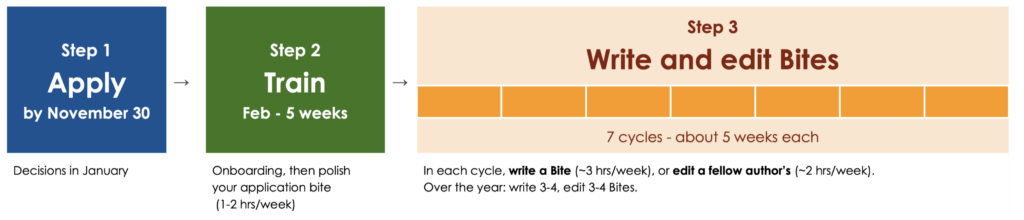
The author year runs in five-week cycles. It starts with a training cycle in February, followed by Bite cycles. Exact dates depend on the cohort, and we’ll share a full schedule at onboarding. In every Bite cycle, you’re either the author writing a Bite or the editor helping a fellow author with theirs. Over the year, that adds up to writing 3-4 Bites and editing 3-4 others.
Inside a Bite cycle
| Week | When you’re writing | When you’re editing |
| 1 | Choose a research article and send it to your editor and senior editor (2–3 hrs) | |
| 2 | Read the paper closely and write a first draft (6–8 hrs) | Read the research article (2 hrs) |
| 3 | Live editing session with your editor (and senior editor) (1–1.5 hrs) | Read the draft, prepare comments, and lead the live editing session (2–3 hrs) |
| 4 | Revise and send a second draft (2–3 hrs) | Edit the second draft and answer questions (1–2 hrs) |
| 5 | Proofread and submit the final draft (1 hr). Senior editors take it from there. | |
| Total | ~12–16 hrs per cycle (about 3 hrs/week) | ~5–7 hrs per cycle (about 1–1.5 hrs/week) |
The training cycle (February – March)
You’ll start with an onboarding meeting, then pair up with another new author for a live editing session with the senior editors, where you’ll give each other feedback on your application posts. You’ll then revise your post for publication. Plan on about 5–8 hours in total.
Who we’re looking for
You’d be a great fit if you:
- Want to dig into the scicomm literature and connect research with practice
- Have some scicomm experience, as a communicator, researcher, student, trainer, or similar
- Have some experience reading peer-reviewed research (in any field, not necessarily scicomm)
- Communicate promptly, meet deadlines, and keep up with cohort messages
- Welcome feedback and enjoy growing as a writer
- Are interested in mentoring other writers and developing your editing skills
What you’ll gain
- Professional growth as a writer and editor
- A deeper familiarity with science communication research
- One-on-one coaching from experienced science communicators
- Stronger teamwork and mentoring skills
- A network of colleagues at institutions around the world
All backgrounds are welcome
Authors on other Science Bites blogs are often graduate researchers in that blog’s discipline. Science communication is different: people come to it from many fields, and we want our team to reflect that. We encourage early-career researchers from all science fields to apply. We especially encourage applications from people in underrepresented groups and from non-native English speakers. If you enjoy writing and want to share the latest science communication research, we want to hear from you!
How to apply
- Get to know our style. Read a few published Bites on scicommbites.org.
- Pick a paper. Choose an original research article on the science of science communication, published in the last five years. It should not be a paper you’re affiliated with, and it must not already be covered on SciCommBites (search our site for the paper title or authors’ names).
- Write your submission materials in your own word processor, following the guidelines below. Leave out your name, affiliation, and anything else that identifies you.
- Submit the application form by November 30, 2026. Paste in your sample post and personal statement, and tell us which tools, if any, you used (see our AI policy below). You’ll receive a confirmation email once your application is complete.
Good to know: if you’re selected, we’ll work with you to edit and publish your sample post on SciCommBites. That’s why it matters that your paper hasn’t been covered before.
Personal statement (<500 words)
Tell us why you want to write for SciCommBites and what you hope to bring. This is also a chance to show off your writing style! Consider:
- Why are you interested in writing and editing for SciCommBites?
- What experience do you have with science communication research, or with writing and communicating about science?
- Editing is a big part of the role. What experience do you have coaching or mentoring other writers, or how would you approach being an editor?
Sample SciCommBite (750–1,000 words)
Below is a table with the basic elements of a SciCommBites post:
| Element | What to include |
| Title | A title that makes people want to click and read (it doesn’t have to match the paper’s title) |
| Publication details | The paper’s title, authors, year, and a link to the published paper |
| TL;DR | 1–2 plain-language sentences on the paper’s key result |
| Why I chose this paper | 1–2 sentences on what drew you to it |
| Intro / lede | The first 1–2 paragraphs: the bigger context, the research question, and the main finding. Make us want to keep reading! |
| Body | Flesh out the intro by answering the five questions below |
In the body of your post, make sure to address these questions:
- The big picture: What larger issue in society or science communication motivated the research? Give readers any background they need, such as a key concept.
- The gap: What wasn’t known? What question did the authors need to answer to make progress?
- The approach and evidence: How did the authors answer their question, and with what data? In a few sentences, describe the study design (e.g., survey, experiment, interviews) and who or what was studied, including how many. Report only the numbers readers need, explain what they mean in plain language, and stay true to what the results can and can’t show (e.g., a correlation is not cause and effect, and a small or narrow sample may not generalize).
- The finding: What was the main thing the authors found?
- Why it matters: How does the finding change our understanding of the larger issue?
Style tips
- Write for an undergraduate audience: skip unnecessary jargon and briefly explain unfamiliar concepts.
- Add links in parentheses for helpful context, such as related SciCommBites posts or other websites.
Our policy on AI tools
We want to hear your voice. Your sample post and personal statement must be written by you.
| Allowed | Spelling and grammar checkers (such as Grammarly’s standard corrections) for final proofreading |
| Not allowed | Using ChatGPT, Claude, Gemini, or any other AI language model, including AI “rewrite” or “generate” features in writing tools, to draft, rewrite, paraphrase, or summarize any part of your application |
| Always | Disclose any tools you used in the application form. Allowed uses won’t count against you. Applications that include undisclosed AI-generated text will not be considered. |
If English isn’t your first language, please don’t let “polish” hold you back. We care most about clear thinking and your perspective, and our editors are here to help with the rest.
Our review is anonymous
We review sample posts and personal statements anonymously, so please don’t include your name, affiliation, or other identifying details beyond what the application form asks for.
The form also asks for optional demographic information. It is kept anonymous and used only internally to check our hiring process for bias.
Questions?
We’re happy to help! Reach out anytime through our contact form.