
Look, and DO touch: designing games for museums

Paper Title: Translating research into play: design insights for evidence-based science games in museum settings
Author(s) and Year: Lisa Bailey, Daniel Lawrance, Allan James, Sarah Azad, Kristin Alford and Brooke Ferguson, 2026
Journal: Journal of Science Communication (open access)
TL;DR: Researchers designed a video game exhibit at a science museum to both teach visitors about their microbiome and promote discussion about the exhibit between visitors. The game successfully communicated that everyday decisions impact the human microbiome, and that the microbiome influences many aspects of human health. This was because the game mechanics directly reflected the educational content. However, visitors did not engage with each other because social interactions were not built into the game. This case study highlights how future video game exhibits can be designed for both educational and social outcomes.
Why I chose this paper: I’m particularly interested in the use of digital games for science communication, and I liked how this paper described the unique design considerations for a game that will be part of a physical museum exhibit.
When you think of museums, you might conjure an image of echoing halls intended for quiet observation. Objects are trapped behind glass as you read the labels silently to yourself: look but don’t touch! However, modern museum design has shifted towards using interactive exhibits to engage visitors and encourage learning and discussion. One way museum designers can make their exhibits more interactive is by incorporating video games.
The Background
Exhibit designers at the science museum, MOD., designed a video game called Symbiosville to help visitors understand how their daily life choices impacted their personal microbiome — the living network of microorganisms that live in and on our bodies. The authors designed the game to achieve three learning outcomes:
- Understand that personal choices in relation to activity and diet can impact the microbiome
- Understand some of the roles of the microbiome in human health
- Engage in subject specific discussions with peers
The first two outcomes assessed visitors’ understanding of the exhibit content, while the latter assessed peer-to-peer learning. The authors evaluated the game to determine if it achieved these learning outcomes, and if the design methods were effective.
The Methods
Game Design
Choosing the core mechanics — how players actually interact with the game — was an important first step in the design process. As the learning outcomes of Symbiosville were about how personal decisions influence the human microbiome, the game was modeled after social simulation games, such as The Sims. These games involve players controlling how their character interacts with the world, which in turn changes the traits and behaviour of their character. In Symbiosville, this was implemented by prompting players with choices, and their decisions would increase, decrease, or have no impact on their character’s microbiome diversity. This was followed by a pop-up message that explained the scientific reason for the change. For example, if players ate artificial sweeteners, their microbiome diversity would decrease and they would see the following message: “Artificial sweeteners cause changes in the microbiome that affect the way we metabolise real sugars, counteracting the reason they’re used in the first place!”
To work out what information about the human microbiome should be included in the game, the authors interviewed four local researchers and performed a literature review. The results of this research were summarised in a table containing each interaction, the microbiome effect, a jargon-free explanation for the effect, and the reference to the relevant paper. This process ensured that the game content was strictly evidence-based and aligned with the current scientific literature.
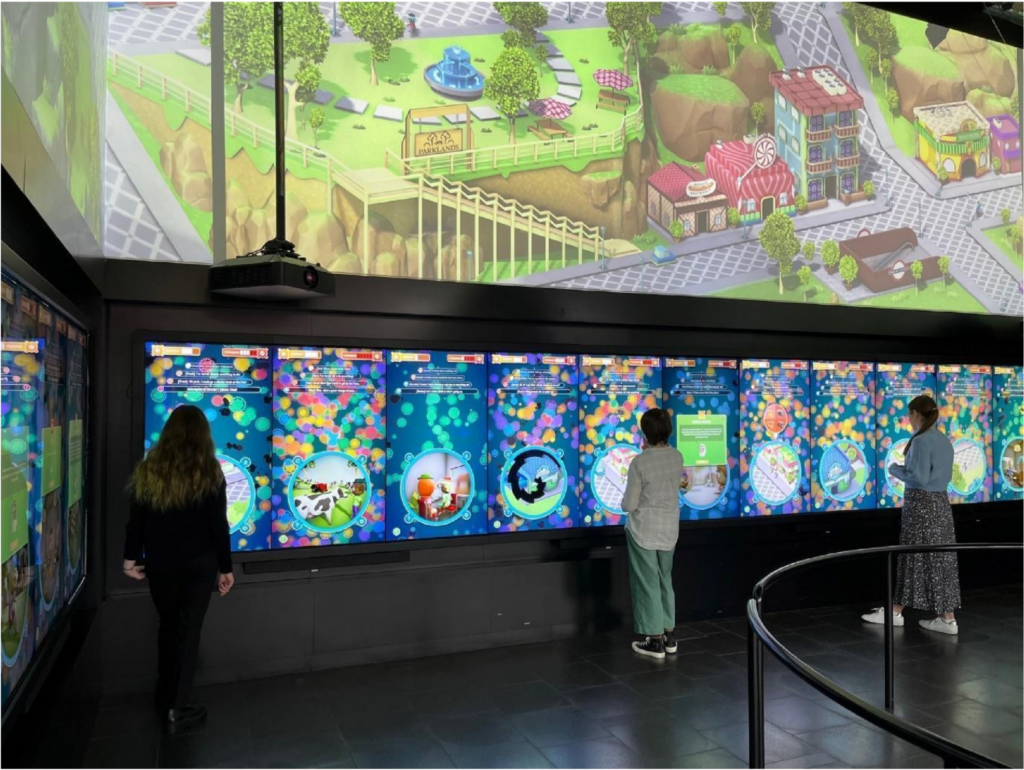
As this game was a museum exhibit, there were additional considerations about how it would use physical space. For example, while the game was played on individual touch screens, the remaining wall space above was used to display an isometric map of the in-game world, showing all the current player characters’ locations and activities. This was designed to create the impression that all player characters were in the same world together and make the gallery space more engaging for visitors who were not actively playing the game. It was also intended to encourage social interactions between visitors: a model of museum participation proposed by Nina Simon suggests that visitors should be encouraged to socially interact through the exhibit design itself.
Evaluation
Fifty visitors completed a survey that assessed their enjoyment of the exhibit and what they learned. The authors also directly observed 118 visitor interactions to evaluate how visitors engaged with the exhibit and each other.
The Results
Players both enjoyed the game and thought that it was an effective learning tool: 88% would recommend it to a friend, and 82% agreed that it was a good way to learn about the microbiome.
Content Outcomes One and Two: Level cleared!
To assess if visitors understood how their choices impact their microbiome and how that in turn impacts their health, the authors analysed visitors’ responses to the question “How would you explain to a friend what you learned about from this game today?”. They found that visitors demonstrated they understood their decisions had an impact on the human microbiome, e.g. “Different things in your life can impact your gut flora”. Visitors could also describe some of the specific health impacts of the microbiome, e.g. “I was also interested to learn the mechanisms behind the effects of poor sleep and the benefits of fermented foods”. Visitors mostly attributed their learning to the explanatory messages that popped up after they made a decision (56%).
Peer-to-Peer Learning Outcome Three: Game over, try again?
The authors evaluated the peer-to-peer learning outcome by analysing the visitors’ interactions in the exhibit space. Despite the projection showing the different player characters together in the same play space, visitors mostly focused on their individual game and rarely interacted with each other. Therefore, this learning outcome was not achieved.
The Impact
Choice-based gameplay was an effective tool to communicate evidence-based research, as shown by the visitors’ understanding of how their actions impact their microbiome. On the other hand, the lack of peer-to-peer learning suggests that the projected game map did not encourage players to interact with each other. This raises the question: what design features could achieve this?
Leveling up
Comparing the features of Symbiosville to the five stages of the model of museum participation can help us to understand why visitors did not interact. First, visitors consume content individually and passively by observing the Symbiosville exhibit. Secondly, they interact with the content individually through playing Symbiosville. Thirdly, the individuals’ interactions are networked since they are displayed together on the projected game map. For these first three stages, Symbiosville has design elements that reflect the model. However, the fourth stage is using this network of interactions for social use. The world map in Symbiosville does not impact the individual’s game experience at all, so it cannot fulfill stage four. This means visitors never reach stage five: socially engaging with each other.
Future museum games could learn from this by building social interaction mechanics directly into the game. Allowing players to interact, compete, or cooperate is more likely to encourage them to discuss their thoughts and feelings about the exhibit, leading to museums full of chatter and interaction.
—
Written by Holly Dear
Edited by Katelyn Miyasaki and Julianna Goenaga
Featured image credit: “War” by Marcin Wichary, CC BY 2.0