

Fear vs. Hope: What Really Works in COVID-19 Health Messaging?

Paper Title: In COVID-19 Health Messaging, Loss Framing Increases Anxiety with Little-to-No Concomitant Benefits: Experimental Evidence from 84 Countries
Author(s) and Year: Charles A. Dorison, Jennifer S. Lerner, Blake H. Heller, et al. (2022)
Journal: Affective Science (open access)
TL;DR: Whether framing COVID-19 health messages in terms of losses works better than emphasizing gains remains an open question in public health communication. Across 84 countries, loss-framed messages increased anxiety but provided little to no additional benefit in promoting COVID-19-protective attitudes and actions compared to gain-framed messages.
Why I chose this paper: I chose this paper because it tackles a nuanced question in science communication of how message framing shapes public responses during a health crisis. With loss-framed messaging widely used in public health campaigns, I was curious whether such an approach actually drives better compliance or simply heightens anxiety. The findings challenged my initial intuition and directly impacted how I will think about communicating scientific information responsibly and effectively.
Special note: This bite was prepared as part of a group project for the Science Communication and Outreach course at KU Leuven.
“Wear a mask. Save lives.” Now imagine the same message rewritten as: “If you don’t wear a mask, lives may be lost.” Which one would actually be more effective? During the COVID-19 pandemic, governments and health organizations constantly made choices like this, deciding whether to emphasize hope or fear in their messaging. But does using more alarming, loss-focused language really motivate people to act?
The Background
During the COVID-19 pandemic, public health communication became one of the most important tools for influencing people’s behavior. Governments and health organizations needed to quickly encourage actions such as mask-wearing, social distancing, and self-isolation. However, beyond what information to communicate, an equally important question is how that information should be presented. Research in psychology has long shown that the same message can lead to different reactions depending on whether it emphasizes potential gains (benefits of action) or losses (costs of inaction).
This distinction, known as message framing, has been widely studied as a way to influence behavior without changing the actual content of a message. Some communicators assume that emphasizing risks and negative consequences will better motivate protective behavior during a crisis, a view actively promoted in major outlets such as The New York Times. However, whether the evidence actually supports this intuition remained an open question
This assumption raises an important concern. While loss-framed messages may capture attention or increase urgency, they may also heighten negative emotions such as anxiety. During a global pandemic, when stress levels are already high, this emotional cost could have meaningful consequences for individuals’ well-being. Despite this, most research on message framing has focused primarily on behavioral outcomes, with less attention paid to its emotional effects.
The Research Question
Given these concerns, this study examined whether loss-framed COVID-19 health messages produce better public responses than gain-framed ones across three key outcomes: behavioral intentions (people’s willingness to follow health guidelines), policy support (endorsement of public health measures), and information seeking (interest in learning more about the disease). The authors investigated whether loss-framed messages meaningfully improve any of these outcomes, or whether they simply increase anxiety without providing additional benefit.
The Methods
To examine how message framing influences public responses, the researchers conducted a large-scale online experiment during the COVID-19 pandemic. A total of 15,929 participants from 84 countries completed the survey in 48 different languages, making this one of the most globally diverse studies on health communication.
Participants were first randomly assigned to read a set of COVID-19 health recommendations adapted from World Health Organization guidelines. They focused on common preventive behaviors, such as staying at home unless necessary, avoiding non-essential shops, wearing a mask in public, and self-isolating after possible exposure.
The researchers then manipulated how these recommendations were presented. Some participants saw gain-framed messages, which emphasized the benefits of following the guidelines, such as “If you practice these four steps, you can protect yourself and others.” The others saw loss-framed messages, which highlighted the risks of not following them, for example, “If you do not practice these four steps, you can endanger yourself and others.” To ensure that the results were not driven by specific wording, each type of message was presented in three slightly different versions.
After reading the messages, participants reported their responses across several outcomes: intentions to follow COVID-19 guidelines, their attitudes toward public health policies, their willingness to seek additional information about COVID-19, and their emotional reactions, particularly levels of anxiety, fear, and worry.
The Results
Emotional Impact
Across countries and experimental conditions, loss-framed messages consistently led to higher levels of anxiety compared to gain-framed messages. Participants exposed to messages emphasizing risks and negative consequences reported feeling more anxious, fearful, and worried when considering the recommendations.
Behavioral and Attitudinal Outcomes
Despite increasing anxiety, loss-framed messages showed little to no advantage over gain-framed messages in influencing behavior. Participants’ intentions to follow COVID-19 guidelines remained similarly high across both conditions.
Likewise, there were no meaningful differences in policy attitudes or information seeking. Whether messages focused on gains or losses, did not significantly change participants’ support for public health policies or their interest in learning more about COVID-19.
A Consistent Global Pattern
Importantly, these findings were highly robust. The pattern of greater anxiety with no added benefit, was consistent across 84 countries, multiple wording variations, and a wide range of analytical approaches. This suggests that while loss-framed messages may heighten emotional responses, they do not meaningfully improve public health outcomes compared to gain-framed alternatives.
The Impact
The findings of this study challenge a view promoted in some major outlets that more alarming, loss-focused messages are necessarily more effective. While such messages may seem persuasive, this research shows that they do not meaningfully improve behavioral intentions, policy attitudes, or information seeking compared to gain-framed alternatives. Instead, their primary effect appears to be an increase in anxiety, which is not the desired outcome of public health communication.
This has important implications for public health communication and science communication more broadly. For practitioners, it suggests that emphasizing benefits rather than risks may be just as effective in promoting desired behaviors, while avoiding unnecessary emotional harm. In high-stress situations like a global pandemic, minimizing anxiety is a critical component of strategic communication.
More broadly, the study highlights the importance of evaluating not only whether communication strategies “work,” but also what unintended consequences they may produce. Future research could further explore how different audiences respond to message framing, and whether certain contexts might justify the use of more negative messaging. Overall, these findings encourage a more balanced and thoughtful approach to science communication that considers both effectiveness and emotional impact.
—
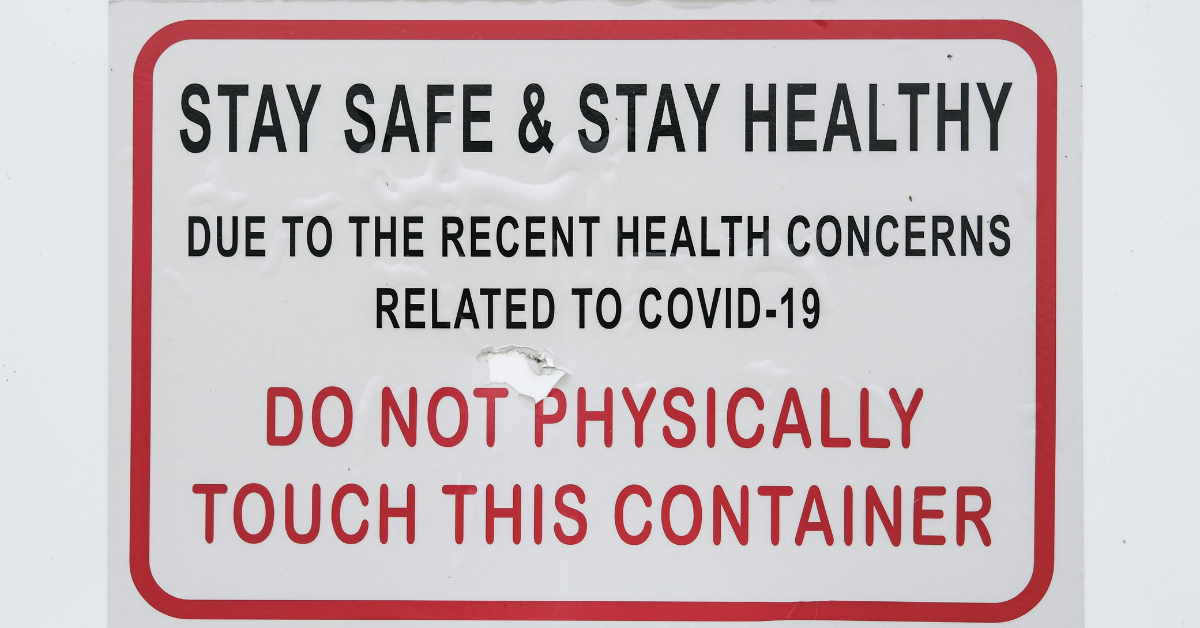
Alt text for featured image: A sign mounted on a wall reading “Stay safe & stay healthy. Due to the recent health concerns related to COVID-19. Do not physically touch this container.”
Written by Ziyao Guo
Edited by Ming Lyu and Mykyta ‘Nik’ Kliapets
Featured image credit:Photo by Rob Martin on Unsplash (Unsplash License)