
From board to engaged: using board games to empower science conversations

Paper Title: Talking genetic technologies and conservation: purposeful games as a tool to level the epistemic playing field
Author(s) and Year: Vicki Macknight, Marie McEntee & Fabien Medvecky (2024)
Journal: Journal of Science Communication (open access)
TL;DR: In this practice insight, researchers modified traditional board games for people to play before participating in a conversation about the use of genetic technologies. The games were designed to empower the players to voice their opinions, and relieve any anxiety about their perceived lack of knowledge.
Why I chose this paper: I am fascinated by the use of games for science communication: their interactivity allows for unique communication strategies that no other medium can offer. Most commonly, I see games designed for knowledge transfer, so the fact that these games were designed to make players feel confident to voice their opinions about science stood out to me.
Many fields are trying to harness the power of games, and science communication is no exception. Games pop up in citizen science projects, therapeutic activities and science education all the time. Usually games are designed to get participants to adopt a new behavior or knowledge. But can we design games to empower people to share the opinions they already have?
The Background
What’s the name of the game?
Engaging publics about potential science and technology developments is essential for ethical science-society relations. In Aotearoa/New Zealand, researchers faced the challenge of collecting and understanding the range of opinions on a contentious science topic: the use of genetic technology for environmental conservation. For example, gene drives, where an edited gene that promotes infertility is very likely to be inherited, reducing the population of pests. Before such a technology is implemented, there are many questions that need to be answered. What is necessary to preserve biodiversity? What is too risky? Who should have the power to make decisions about it?
It can be very intimidating to weigh in on these questions in a group setting. The researchers were concerned that participants’ epistemic anxiety, that is, the feeling that you don’t know enough to form an opinion, might prevent them from contributing their thoughts. This is a massive problem: the opinions of diverse, non-scientific audiences are particularly valuable because they are non-scientific, and offer a different perspective. If they feel they can’t contribute due to a lack of perceived knowledge, researchers and policymakers miss out on many local and contextual insights that could help make more equitable decisions.
The challenge therefore, was not to shape the knowledge or opinions of the participants, but to make them feel that they had enough knowledge to form opinions, and empower them to discuss them openly. Can we design science communication games to achieve this outcome?
The Methods
New Zealanders were invited to discuss the broad possibilities of genetic technology in group discussions. Before entering facilitated discussions, the participants played a series of analogue games together. The games needed to be simple and quick to learn, so the researchers modified the rules of well known heritage games.
The Games
“Ecological Collapse” was based on Jenga. Players took turns pulling blocks from the tower, which represented the health of an ecosystem. Each time they pulled a block, they read a card that described a positive or negative impact on the ecosystem. For example, “Visitors introduce a new plant disease into the forest that kills trees and spreads rapidly. PENALTY: REMOVE ANOTHER BLOCK FOR THIS DISEASE SPREAD.”
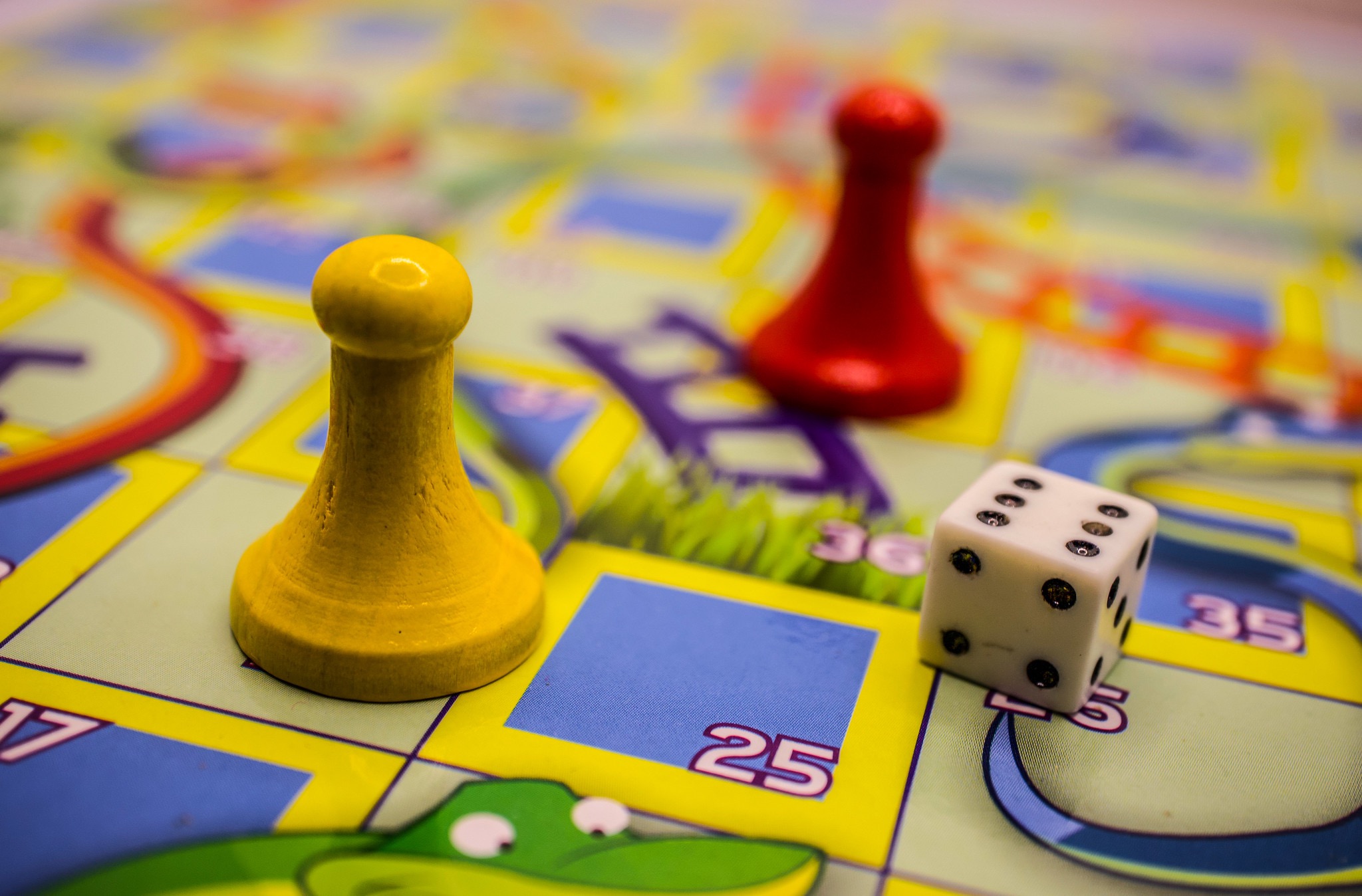
The game “Snakes and Helixes” was based on snakes and ladders. The players took on the role of scientists researching genetic technology. When they landed on a snake, the board described a negative research outcome, such as: “unexpectedly disrupts essential genes”. When they landed on a ladder, the board described a positive research outcome, such as: “enhancing border security”.
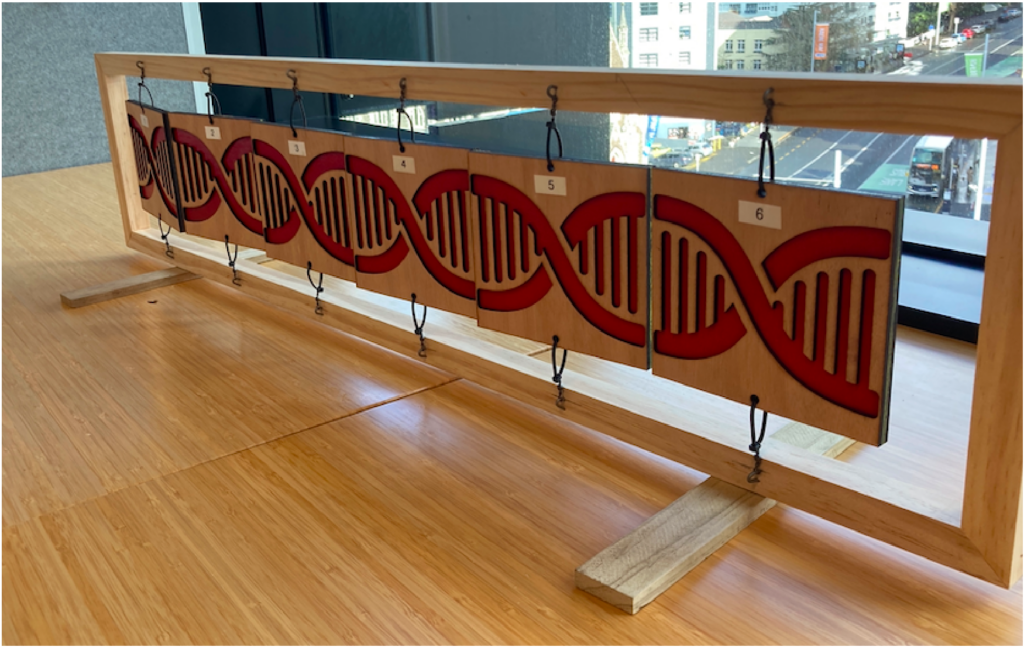
The “Gene Editing” game was similar to ball throwing carnival games. A model of a DNA double-helix was placed a short distance away from players. Players tried to hit specific segments of the model to spin them around, which represented them successfully editing the target gene. Players spinning an incorrect segment represented an “unintended consequence”. More details about the rules of the games can be found in the project’s full report.
The authors gave participants exit surveys to find out how they perceived their experience. It’s important to note that when the participants were filling out these surveys, they had experienced both the games and the facilitated discussion, so either may have influenced their responses.
The Results
The exit surveys showed that participants felt that the games were successful at making them more comfortable. In fact, more than 75% of participants said that they felt more confident participating in conversations about genetic technology in the future.
Participants also said that the games helped to illustrate the scientific principles they would be discussing:
“Jenga game was a very effective method to show the impact one thing
has on others.”
They also said the games were successful at facilitating discussion among their fellow players:
“I feel it shows us all that we are capable of expressing our beliefs in this
space.”
And most importantly, they enjoyed the games!
“It was cool to see different perspectives. Games were also very fun.”
Overall, this suggests that the participants felt that the games made them feel more comfortable contributing to a scientific conversation, potentially because their epistemic anxieties had been eased.
The Impact
The experience of the participants suggests that board games could be a good tool to empower participation in science discourse. While these results are limited as we cannot know if participants would have had the same perception of the group discussion without playing the games, it presents a pathway for science communication games to develop beyond behaviour change and knowledge transfer.
From playful to serious: what’s in a game?
Within the landscape of science communication games, the authors position these as purposeful games: between playful and serious. Serious games are designed for explicit, functional, non-play purposes, whereas playful games are the standard recreational fun we enjoy day-to-day. The researchers criticise “the dualism of serious therefore important, vs fun therefore pointless” that serious games imply: in fact, the games were designed to be enjoyable to foster collaboration between the players. It’s worth noting that one of the original definitions of serious games specified that despite having a functional purpose “this does not mean that serious games are not, or should not be, entertaining”. So in some ways, this paper echoes the original vision of serious games: a combination of fun and functional outcomes that reinforce each other.
—
Written by Holly Dear
Edited by Abigail A. Agbaze and Sarah Ferugson
Featured image credit: [monkeyc.net] CC BY-NC-SA 2.0